

Diver Post #8
Object study and tracing a helmets history outward.

Hello reader, deep diver,
I owe you one, it’s been a little while since I last filled your inbox with dispatches from the helmet room. The past couple of weeks have been full… other writing commissions, last-minute edits, and a bit of necessary living to turn the wheel and start the circle again.
This time last week, I was in Wales, throwing myself and my push bike down the sides of mountains. A different kind of immersion, but not so far removed from the kind we talk about here. The kind that fixes your attention, bringing you close to the edge of control, asking you to stay with what’s directly in front of you.
Being away from the helmet room (out of my own head and, at times, a little out of control on the mountains) had me thinking about focus, about how to return to this archive, about the kind of purpose it’s serving and how I can meet the things it serves with care. Equally, I thought about what brings you, as a reader here. What you might want more of… or less of from Diver Post (?)
For me, this diving space is deeply personal. I’m trying to understand what my father left behind, and diving is the thread I’ve chosen to follow. The helmet room is where I return, a space I sit in, sensing it’s leading me somewhere, even if I don’t yet understand where that is. What I do know is that the further I trace the lineage of these helmets, the more people I meet, and the deeper my enquiry becomes. My focus sharpens, my understanding of depth expands. The helmets become tools within my grief, teaching me, in their own way, how to breathe again.
Over the last week I took a couple of deep breaths, whilst circling back around to the Heinke Pearler helmet I posted about a few months ago. I made a bold statement when I explained in one of my previous posts that this was one of the most visibly worked helmets in the collection….only now am I starting to understand why.
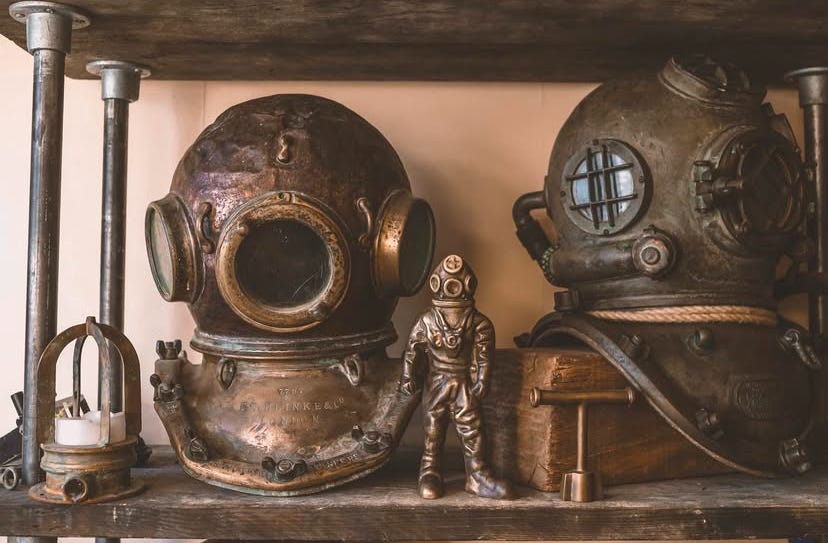
As I’ve said, the helmet is tactile, worn, its bonnet beaten, its surface showing the work it has endured. Yet, sitting silently on the shelf, it’s impossible to fully grasp the labour it has known. While the others hold that assured, forward-facing presence, this one lowers its faceplate, angled deliberately downward, as if its purpose was never to meet the world head-on, but to look beneath it. It carries a different kind of intent, less about projection and more about what sits below the line of sight.
Staring at it on the shelf where it now sits retired, it still holds that same downward glance, unchanged by time, as though its attention remains fixed on something just out of reach below. Something about that fixed attention to the floor stayed with me, impossible to ignore, so I began to follow the helmet through its material details, tracing it’s history outward.
What I assumed would be a simple study of an object slowly unfolded into something far wider, a story that extended well beyond the object itself….
Although the Heinke Pearler was manufactured in England, it didn’t spend long there. It was shipped to Australia, where it became part of the pearl diving industry off the north-west coast.
Of course, long before the helmet arrived, the work already existed. For thousands of years, Indigenous communities had collected pearl shell, wading at low tide, free diving without equipment, and trading shells like water totems across vast inland networks and songlines. By the mid-1800s, however European operators moved into the region, and Aboriginal men and women and Torres Strait Islanders were drawn, often forcibly, into the industry as divers. As demand grew, so did the pressure on the seabed. Oyster beds that had once been easily reached were stripped back, forcing crews further offshore and into deeper water. What had begun as shallow collection became something more extractive, more distant, and much, much more dangerous.
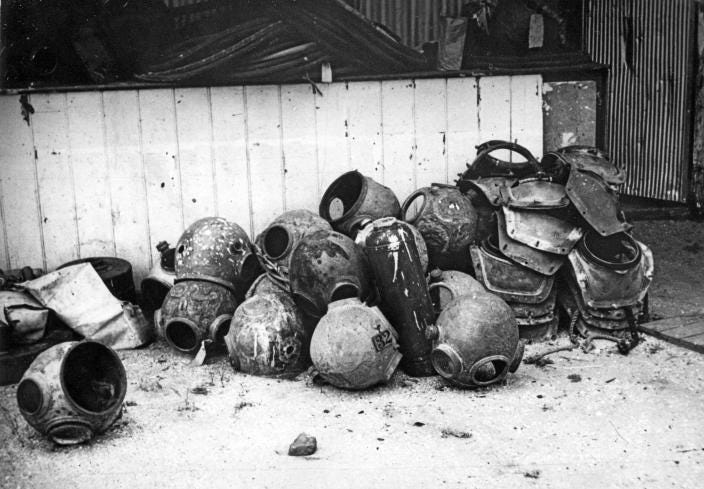
Labour shifted with it. Divers were brought in from across Southeast Asia and Japan. These were known to be some of the best divers, drawn into an industry that relied on their skill, but rarely offered stability, recognition...or safety! All of this sat within the framework of the White Australia policy, which restricted non-European migration while still allowing industries like pearling to depend on it. A system that exploited people it officially refused to recognise, that made space for the work, but not for the people doing it.
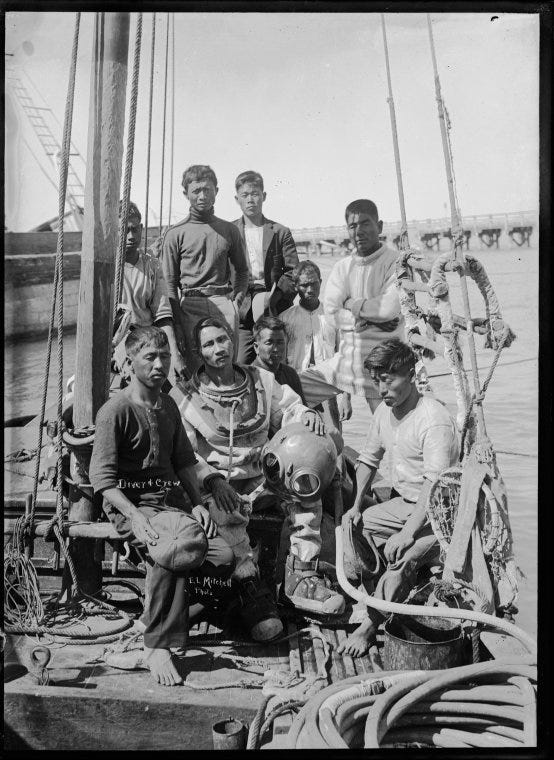
In my research I have found some images I’d like to share of just some of these pearl divers and lugger crews. I’m currently working on further research to understand this history better and accompany a longer form essay. In just touching the surface, my understanding of this helmet, once rooted in simple aesthetics, has shifted. I see now a helmet, engineered for survival, tethered to a different kind of legacy. It speaks to the danger and bravery these crews worked under, it whispers an all too familiar thread of that era, of what happens when knowledge is appropriated and displaced by industry. It speaks to the quieter forms of grief that accumulate in landscapes that have been commodified and stripped over time.
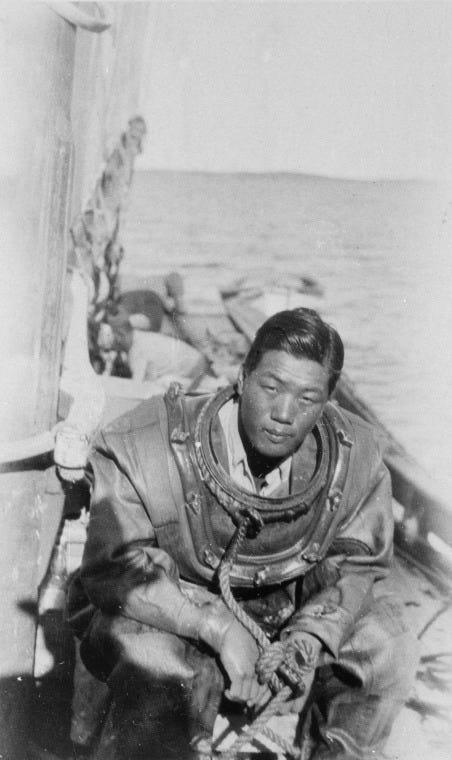
This diving culture was a pursuit built on a rarity of the mother of pearl, only for its value to fade, first with the introduction of plastics, then as cultured pearls made it possible to produce something that no longer required the sea at all. Pearl diving in Australia today is a modern, high-tech, and tightly managed industry. It is centred around Broome and the Kimberley in Western Australia, but it remains rooted in a history of danger and multiculturalism. While the hard-hat diving era of the early 1900s has passed, the skill of divers who hand-collect wild oysters is still valued, now under strict environmental regulation.
Staring into the faceplate of the Heinke Pearler, I’m struck by how little I can truly know about the life it once held. I don’t yet know whether this helmet spent its life in Australia or whose hands and labour shaped its story. I do know, from its features that it has both lived and served and although I won’t ever fully understand the experiences and cultural knowledge tied to this object, I know it was used. That someone once lived by and worked within this heavy, enclosing form. Now it rests permanently on a shelf, silent, removed from the conditions that gave it meaning.
Cleaning the dust from the face plate, I wonder now if its downward-tilted gaze was no accident. It speaks for an industry that demanded a narrow focus, a posture held in descent, the diver looking only downwards, bent toward the seabed, searching, selecting, collecting, extracting. With all its knocks and dents the helmet carries traces of that work, the endurance required, and the significance of history that quietly settles into both people and landscape. In its silence, it asks a quieter question.
How far removed have we become from the places and labour that shape what we value?
What is worth bending toward, and what do we fail to see in the pursuit of what we desire?
Here are some links to things that might be of interest:
Growing up in old Broome - ABC listen
From the deep,
the divers daughter x
Freedom without awareness can be risky, posts like this remind us that real freedom comes with responsibility. That’s what keeps the ride going.