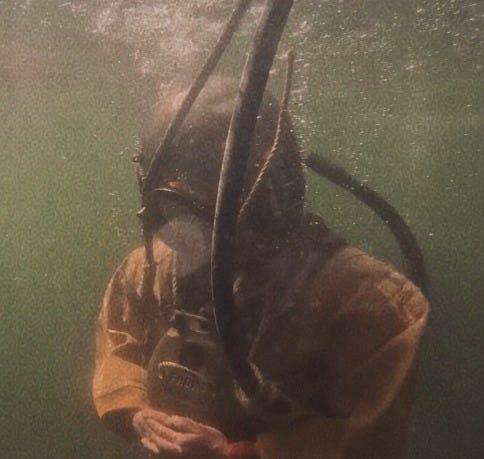
Diver Post #10
Tenderness and the ritual of dressing a diver

We like to believe our days are shaped by choice, but most unfold along grooves worn so deeply they no longer feel like decisions. We wake, we reach, we move, each action following the last with an almost unconscious predictability, whether we notice it or not. Habit is subtle like that, disguised as preference, a kind of comfort or maybe instinct. Some habits matter more than others, they steady us, settle the nervous system and carry us through the day. Yet when we begin to notice them, when we recognise their role and choose to engage with them consciously, they stop being purely reactive movements and become intentional. Action becomes deliberate, a choice. Gestures performed with attention begin to take on weight.
This is where ritual begins.
Last week, I travelled across the country to meet the historic working divers group. The first time I met with them last year, I was overwhelmed (in the best of ways) not just by the machinery, but by the atmosphere surrounding it. These were objects I had only ever known as static, fixed to the shelves in the helmet room. Suddenly they had movement, and what I had connected in my mind, to my home, my father, to grief and to the slow process of learning how to breathe again after his death were no longer held in a stillness. The pump turned, the helmet filled with air, and what had once felt distant and fixed became active. Watching all the moving parts working as they were designed to. I felt something shift in myself, as if breath had returned not just to the apparatus, but to me.
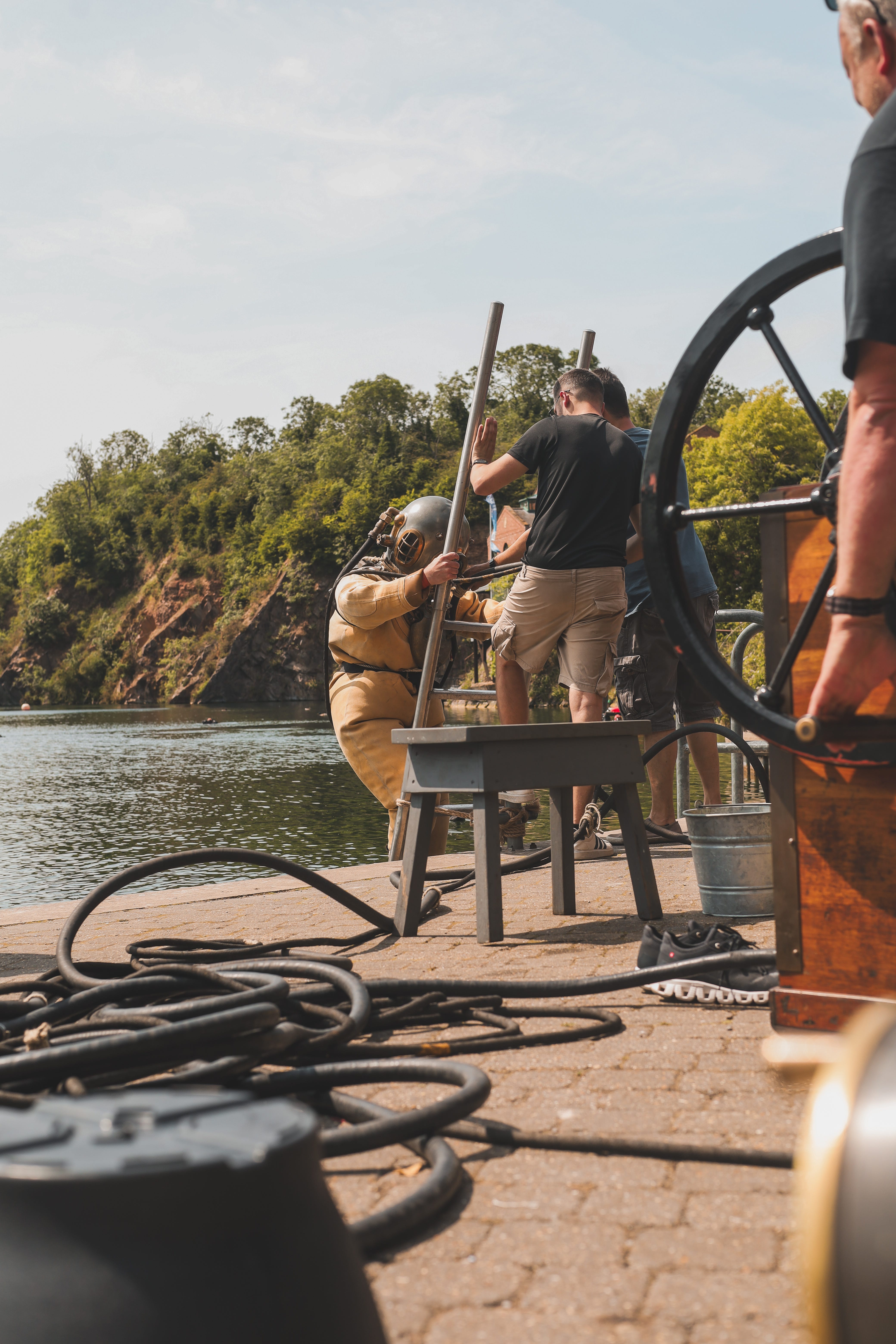
I knew this time I wanted something to be different. I wanted to be present, to step inside the ritual of preparation rather than stand outside it. So I arrived with intention: to observe, to learn, to understand how a diver is dressed. There is a precise method to it and I wanted to understand every part of it.
To watch a diver being dressed in the old hardhat tradition is to witness more than preparation. It does not carry the same careless familiarity as the way we dress ourselves each day. Part of what makes it so striking is its visibility. We rarely watch someone being dressed; it is typically a private, unobserved act. Yet here, nothing is hidden. Each stage is exposed and carried out in the open, performed by a group, turning the process into a collective rite of passage enacted through canvas, rope, metal, and human hands. This ritual acts as way of turning someone into something capable of entering a place where they don't belong. Each gesture in their practice is repeated with purpose until an ordinary body is gradually transformed into something capable of crossing a threshold.
No diver dresses alone, the process depends on others, on a team. The one who leads the dressing is often called a tender or dresser. There have been attempts by divers in the past to modify equipment so a diver could dress themselves, but these are exceptions. The practice, in its truest form, is communal. It relies on trust, coordination, and a shared understanding of sequence. The diver yields control, piece by piece, to the hands of others.
The canvas suit comes first. It is plain, but beautiful, practical and heavy. The diver becomes encased in


a second skin, sealed by rubber at the wrists, and booties at the foot. For smaller wrists, chamois and rubber bindings (called greys…even though Nick’s were orange) seal the openings, acting as additional seals of resistance against the pressure and seep of another world.
Then come the boots, weighty and grounding, fastening the diver to the earth before he leaves it behind.


A cushion was placed across the shoulders beneath the suit, a kind of bedding preparing the body to carry a weight that is not yet present.
Then the breastplate is worked into place, fitted carefully over the head, it rests upon the shoulders, between a rubber collar and the canvas of the suit. It does not merely attach, but finds its seat, as if designed to belong there. The bolts on the breastplate are threaded through the collar.


Brails (or brasses) are attached fastened with nuts front first, then back, the shoulders are left until last. The order matters, I am told, preventing strain on the brails it also ensures a kind of balance, keeping the apparatus from pulling against the throat. Even here, in metal and pressure, there is care for both equipment and diver.
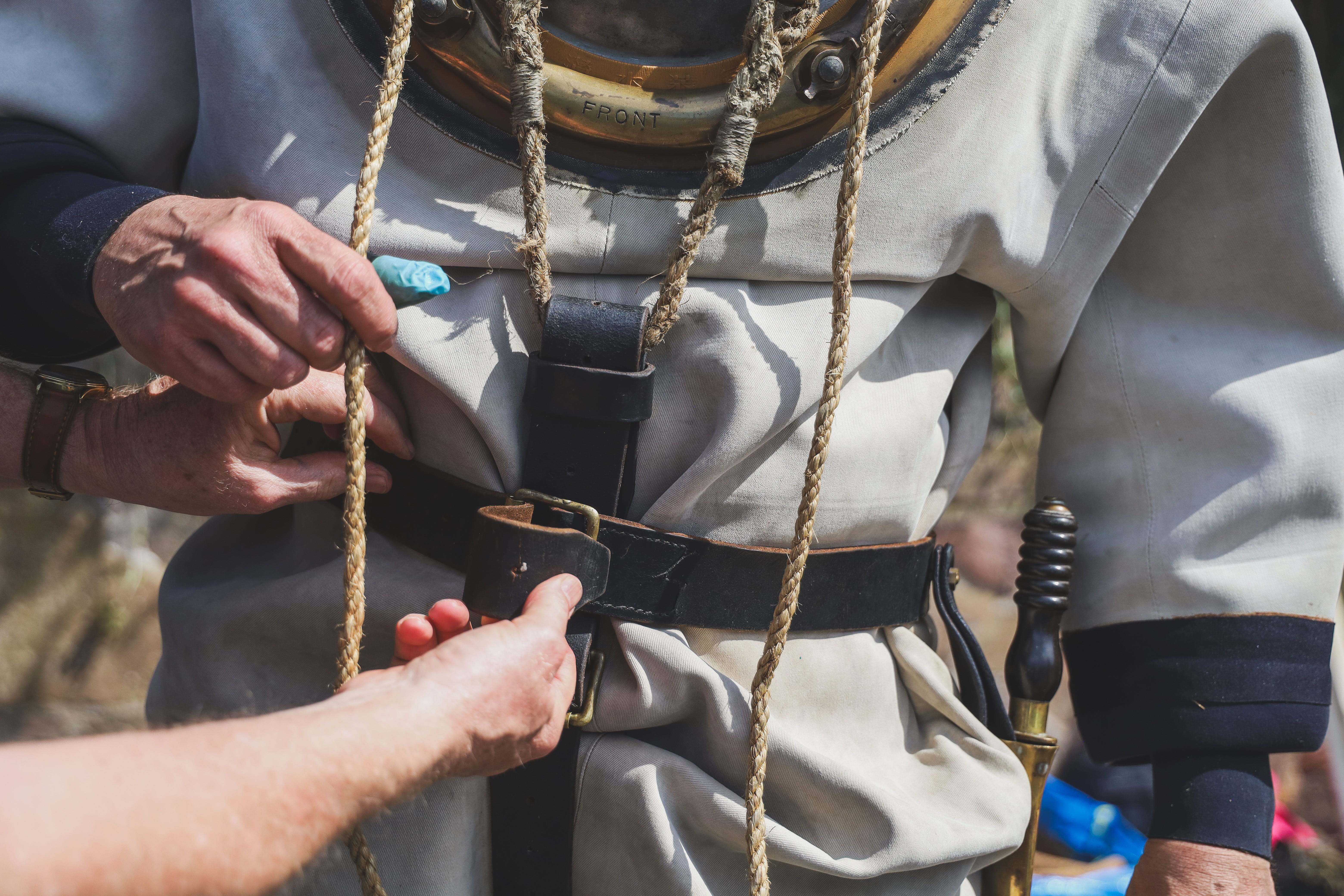
The jockstrap is secured next, adjusted precisely by the tender to hold the diver upright within the suit. A belt is tied at the waist, a knife on the left. Air and communication lines are arranged beneath the arms with practical knots.
Then the helmet is lowered into place and secured to the breastplate with a certainty that only repetition can produce. The tender seems to know instinctively where the thread begins, where it will catch. As the helmet closes, the diver disappears inside it, but not entirely, there is still communication, still breath, still presence. Something starts to shift, with the faceplate not yet fastened, there is still a trace of the person, still an ability to see facial expressions.
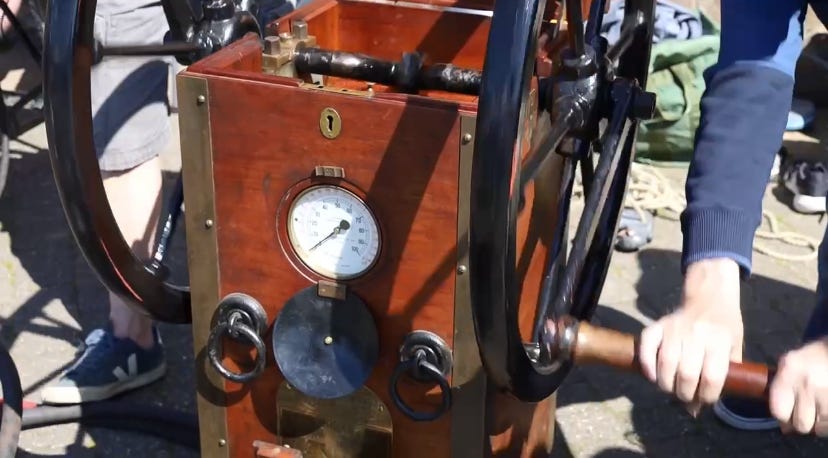
Air begins to flow from the pump, two members keep a wheel turning at either side. This is purely to keep the diver cool, above surface but I think it also helps for diver the listen to their own breathing. Following the rhythm of it, falling into character as identities begin to shift. The person inside is not erased, but reframed, becoming less individual and more figure, more a part of all the moving parts, keeping them alive. They are now not just a person, but an emissary between environments.


Weights are fixed to chest and back, among the heaviest elements of the process in my eyes. The diver braces as they are attached, assisting where he can. The tender uses a slipknot to allow for release if needed and I think even here, in these final stages securing staging, when diver is heading closer to committal, there is an awareness of risk…of the need for escape.
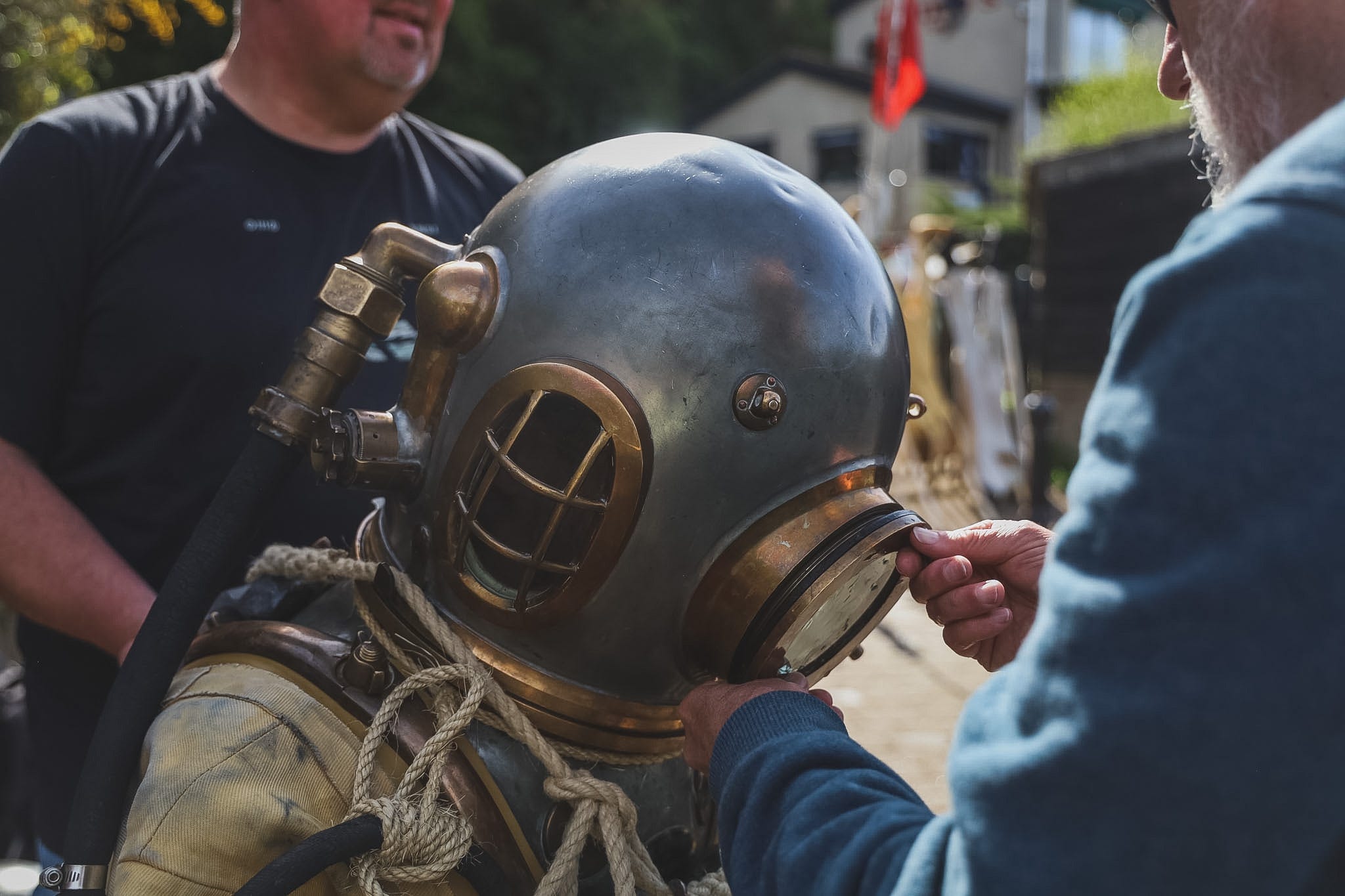
Finally, the faceplate is secured, this is the closing of the system. The moment the transformation completes, but before the diver walks, the dresser checks everything, every knot, every strap, then, the true final act itself.
Two taps on the top of helmet, a simple yet unmistakable gesture, part signal, part reassurance, a final communication, close to a blessing.
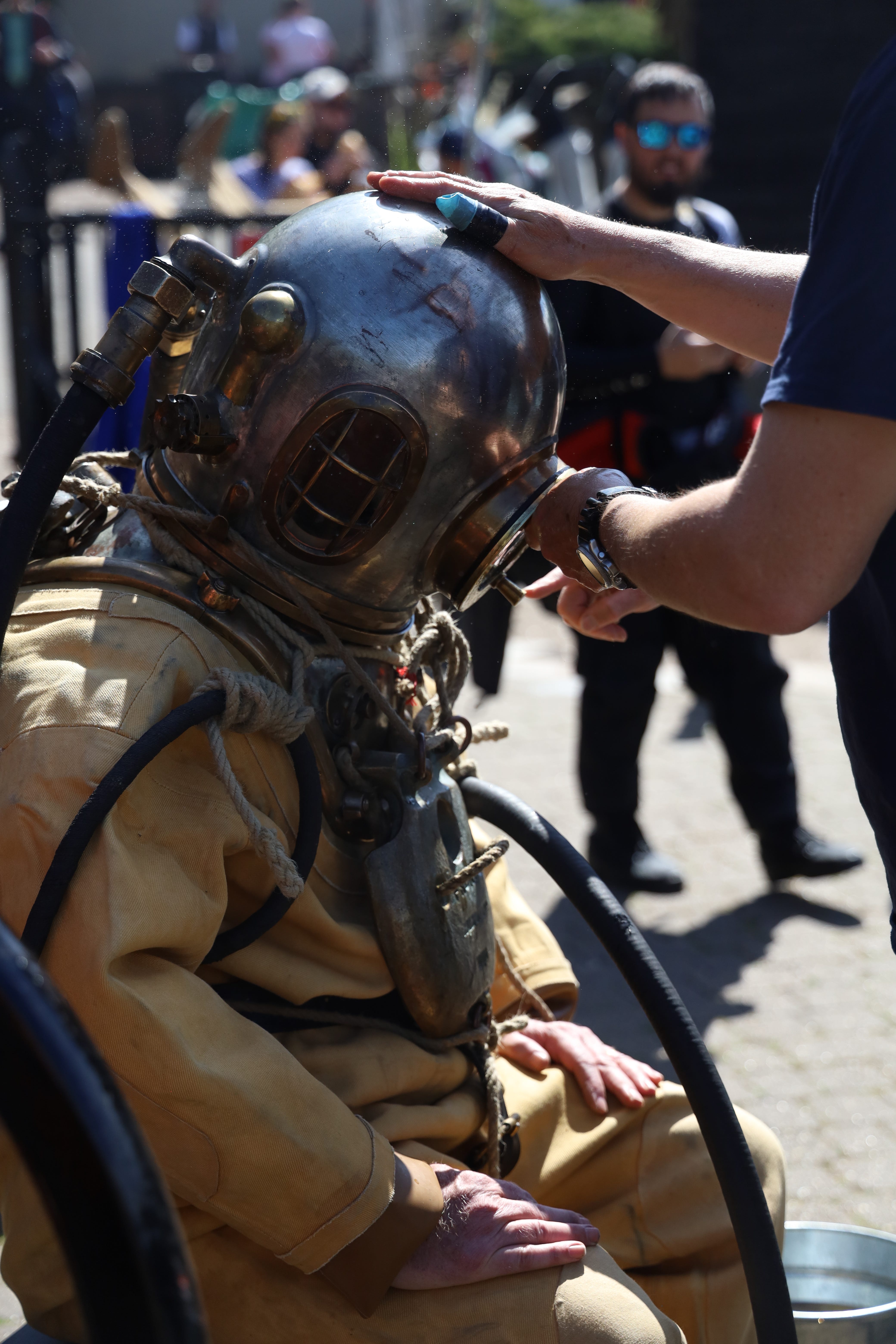
The diver responds not with words, but with movement and he steps forward.
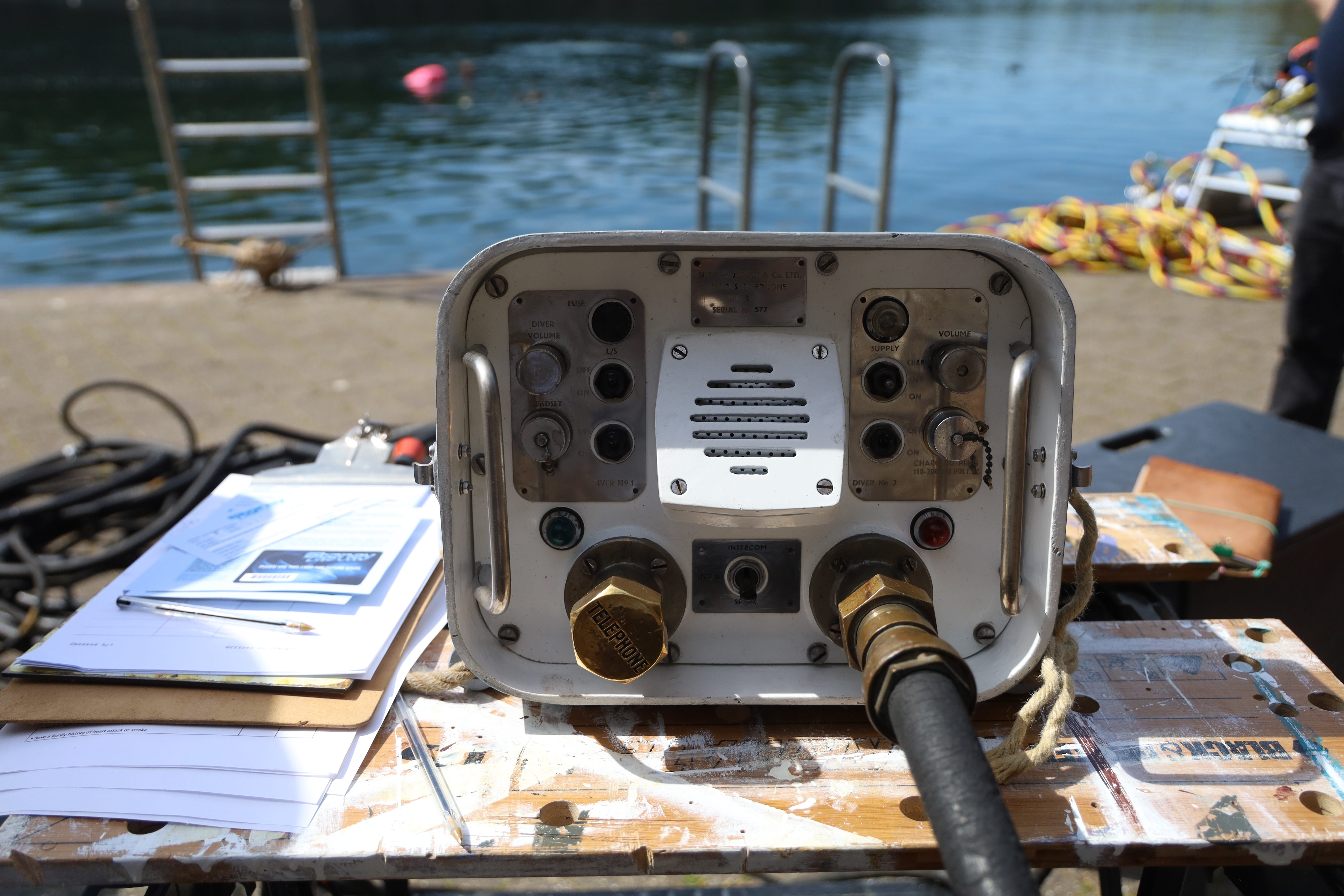
Communication from this point now is minimal, relayed through a hard-wired system, a voice carried along a line, reduced to essentials.
“Diver okay?”
“Yes.”
Nothing more than what is necessary, as language, like movement, becomes functional.
This is where ritual reveals its purpose most clearly, at the edge of uncertainty. Where habit might falter, ritual holds. It provides sequence, structure and safety. Each gesture becomes part of a language older than the individual performing it. One that says “We do not enter the unknown casually, we enter it prepared, together, and with care”.
The diver has not yet entered the water, and yet the transformation is already complete and being held together by others.
In learning to dress a diver, I began to understand that the ritual is not secondary to the dive, it is integral to it. To take part in that process, to fasten, to adjust, to check, is to share responsibility for what follows. It demands attention, patience, and trust. As the tender you are drawn into the same threshold the diver will cross.
A tender…I wonder…. if the word is accidental, the name feels very apt. There is something inherently tender in the act itself, tending to another diver carries real consequence. It is not symbolic, but practical and requires the kind of care that, when done correctly, is intended to keep someone alive.
We do not often find ourselves in situations where tending is so directly tied to survival. I think of the shoots of vegetables in my garden, that is also tending against survival, but it feels more forgiving, less absolute. I think about how we tend to the poorly, a job often compartmentalised or carried out by professionals. Then, I think to my nephew and to parents out there who tend to and perhaps we are tending or have a duty to tend to others more often than we notice. In the way we show up, in our attention, in patience, in the small acts of maintenance that hold relationships and people together.
Maybe tending is not exceptional at all, but a ritual that sits closer to daily life than I had once thought.
There is something deeply grounding in that and almost therapeutic in the precision, the shared focus of a ritual that quiets everything else. Ritual, after all, is not just about meaning, but about practice, about returning, again and again, to the same sequence until it begins to shape you in return.